04 Oct 2026
Wall Panel 21C White Oak: pale planks, joints and pack maths
This guide is about
Wall Panel 21C - White Oak - Seamless - 240cm - (1 pack / 8pcs)
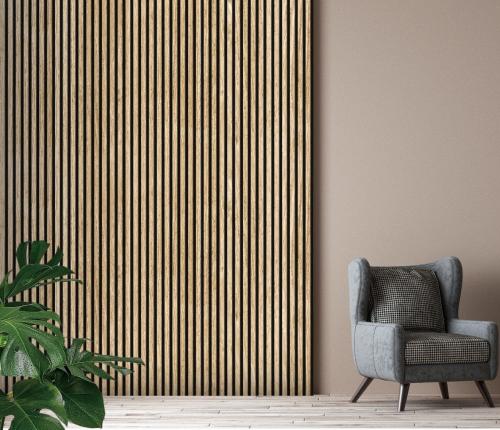
Pale panelling is less forgiving than dark panelling, and not for the reason people expect. Marks show less on a light surface than on a black one. What shows more is the wall behind it. Wall Panel 21C in white oak is a flat, tongue-and-groove plank, listed at 30 x 240 x 1.2cm with eight planks a pack, and a flat pale wall reports every hollow and bump underneath it.
A pale flat wall shows the surface behind it
Light falling along a wall at a shallow angle picks out anything that is not flat, and a white oak face reflects more of that light than a dark one does. So the preparation matters more here than the panel does. Run a long straight edge over the wall before you order, in several places, and look for rocking. Where the wall is out, a thin plank bridges the hollow and the joint line in front of it goes wavy, which is the detail you notice from the sofa. Battens, or filling and sanding, fix it beforehand; nothing fixes it afterwards.
The numbers, and the run they give
- Plank: 30 x 240 x 1.2cm, as listed
- Eight planks per pack
- 5.76m2 covered per pack
- Tongue-and-groove joints, described as giving an installation with no visible gaps
Eight planks at 30cm give a 2.4 metre run at the listed 240cm height. Two useful sums follow from that: wall width divided by 2.4 metres is your pack count rounded up, and wall width divided by 0.3 metres tells you how the planks fall. A 3.6 metre wall is twelve planks exactly, which is two packs with four planks spare. A 3.5 metre wall is eleven planks and a 20cm piece, and that last narrow plank is the one to think about now rather than on the day.
Where to put the cut plank
On a run between two corners, split the difference: take the same amount off the first and last plank so the wall reads symmetrically. On a run that stops partway along a wall, put the cut at the stopped end and finish it with a trim. Where the panelling meets a window reveal or a door, put the cut there instead, because the architrave and the reveal break the eye's line anyway. Trims for all three cases are in panel trims and fittings.
What the description claims, and what it omits
The description calls this a PVC wall panel and in the next sentence refers to a three-sided oak veneer, and the two do not sit easily together on one face. The same paragraph appears word for word on the oak and grey panels in this format, which points to shared text, but a veneer and a wood-effect PVC surface clean and wear differently, so ask the shop which this is. The rest of that paragraph praises the panel without publishing anything measurable, and the listing carries no fire rating, no cleaning instructions, no fixing method, no panel weight and no colour reference for the white oak itself. There are several photographs on the product page and they are the most reliable guide to the tone, since a name like white oak covers everything from near-white to a pale honey.
Finishing it, and what else to look at
The wall panel adhesive is ordered separately, as are the trims. If a plainer tone would suit better, Wall Panel 21B in grey is the same plank in grey, and Wall Panel 21T in walnut is the dark end of the group.
Once the wall is measured and the plank count worked out, the figures, the photographs and the delivery options are on the Wall Panel 21C white oak page, with the rest of the format in slat and acoustic panels. Delivery is free within 50 miles of our Glasgow store and £50 beyond.