04 Oct 2026
Wall Panel 15E Black: panelling the wall behind a television
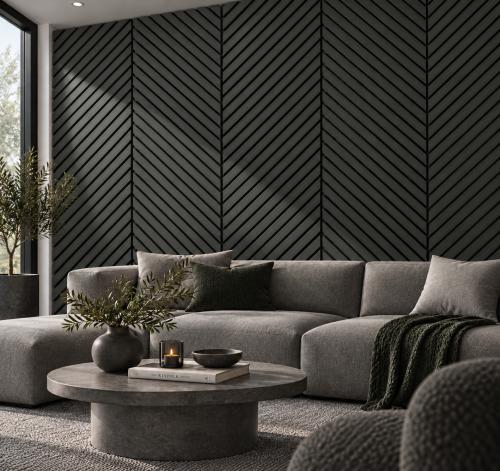
This guide is about
Wall Panel 15E - Black - Acoustic - 240cm - (1 pack / 4pcs)
The wall behind a television is where slat panelling earns its keep. A black screen on a pale wall is a hole in the room; a black screen on a dark ribbed wall is part of it. The Wall Panel 15E in black is the darkest finish on this profile, with 3.5cm slats and 1.5cm gaps on a felt backing, four panels to a pack at 60 x 240 x 1.5cm each.
Black behind a screen
Two practical reasons it works there. The screen's bezel stops being the darkest thing on the wall, so the eye reads the picture rather than the frame around it. And the ribs give the wall a scale, which a flat dark wall does not have, so a large television looks like it belongs rather than like it was hung on a void.
It is less forgiving everywhere else. A black panel absorbs light, so a small room or one lit from a single window will feel darker for it. Panel the wall opposite the window rather than the one containing it.
The gaps show the backing, and its colour is not stated
Every 1.5cm gap on this panel shows the material behind the slats. The listing names that material as a felt backing but does not state its colour, and on a black panel the difference between a black felt and a grey one is the difference between deep shadow lines and visible stripes. It is a short question to ask us and a long thing to live with, so ask before you order a whole wall.
Panels, packs and the sliver at the end
| What | 15E |
|---|---|
| Panel size | 60 x 240 x 1.5cm per panel |
| Slat width | 3.5cm |
| Space between slats | 1.5cm |
| Pieces per pack | 4 |
| Area covered | 5.76m² per pack |
| Code | AWS-WP025 |
One pack runs 2.4m along the wall at full height. Most chimney breasts and media walls land between two and four panels, so the quantity is rarely the problem; where the last panel falls is. If the wall leaves you a 10cm strip at one end, move half of it to the other end so both margins match, or widen the panelled area slightly and finish it with a trim rather than tapering into a corner.
Brackets, cables and the fixings underneath
Anything heavy on a panelled wall is still carried by the wall, not the panel. Three things to sort out before the panels go up, none of which the listing covers:
- The bracket. Mark and test the fixing positions in the bare wall first. A screen bracket needs fixings long enough to pass through a 1.5cm panel and still hold properly in the masonry or the stud behind it.
- The cables. Run and label them before the panels are fixed. The gaps between slats are not a cable route, and chasing a missed HDMI lead afterwards means lifting a panel.
- The sockets. A socket behind a television needs its faceplate bringing forward onto the new face, which is work for an electrician.
The listing gives no fixing method and no weight per panel, so tell us what the wall is built of and we will say whether the panel adhesive suits it or whether it wants battening.
The nearest alternatives to black
If black is too strong for the room, Wall Panel 15F in dark grey keeps the same profile a step lighter, and 15T in walnut swaps the darkness for warmth. For black on the wide-slat version of this profile, compare Wall Panel 17E, and the full set of finishes is in Slat & Acoustic Panels.
On sound, the listing says the felt backing absorbs sound and reduces noise transmission, and quotes no absorption figure, no class and no test standard. Behind a television that is a fair description of what a soft ribbed wall does to a hard room; it is not a measured performance. Delivery is free within 50 miles of our Glasgow store and £50 beyond. When the wall and the bracket are settled, order the Wall Panel 15E black acoustic pack in whole packs.