04 Oct 2026
Slat Panel TV Walls: Pairing a Panelled Wall With the Right TV Unit
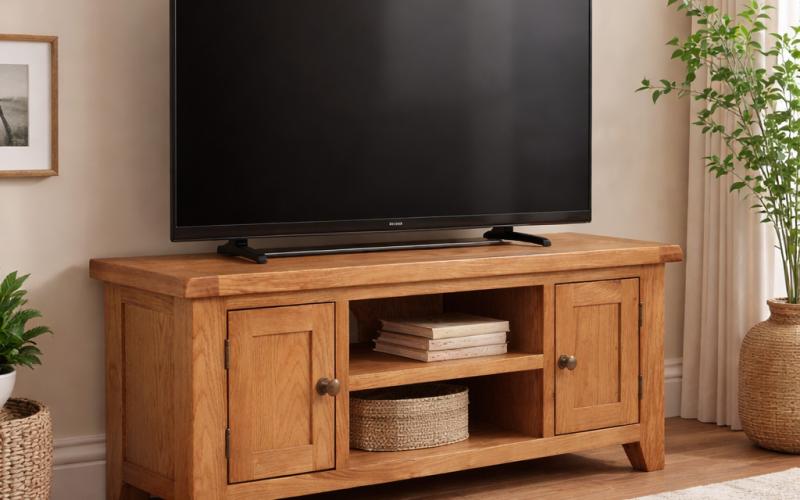
The panelled wall behind a television is the version of this that people ask about most, and it is the one with the most ways to go slightly wrong. The panelling is straightforward. What needs thinking about is the bracket, the width of the panelled block against the width of the unit below it, and where the cables are going to run.
This walks through all three, using the panels in the Slat & Acoustic Panels range and the units in TV Units & TV Stands.
Settle the bracket before you order the panels
A wall-mounted television fixes into the structure behind the panel, never into the panel itself. That means the panel's thickness is added to the depth your fixings have to reach, and the panels in this range vary more than you would expect:
- PVC wall boards are 0.7cm thick.
- PVC slat and seamless boards run 1cm to 1.8cm.
- The seamless 21 series is 1.2cm.
- Acoustic slat panels are mostly 1.5cm or 1.7cm, with the 37 series at 2.2cm.
There is a second wrinkle with slatted panels. A flat bracket plate bears on the slats rather than on the wall, so whoever fits it will either cut the panel back where the plate lands or pack the fixings out to the panel face. Which is right depends on the bracket, the wall and the weight of the screen, and it is a question for the person doing the fitting. We sell the panels; we do not fit them. Ask your installer before you order, because the answer can change which thickness you want.
The practical consequence: decide the bracket and the fixing method first, then choose the panel. Doing it the other way round is how a wall gets panelled twice.
Match the slat to the size of the screen
A large dark rectangle sitting on a finely slatted wall reads as busy. The slat pitch is stated on each listing, and it is the single biggest visual decision:
- Wall Panel 01A — 2.5cm slats with 1.5cm gaps. Fine and close-grained, and it reads more comfortably from across a room than up close.
- Wall Panel 15A — 3.5cm slats, 1.5cm gaps. A middle rhythm that suits most living rooms.
- Wall Panel 37H — 4cm slats, 1cm gaps. Broader slats, tighter shadow lines.
- Wall Panel 17A — 5cm slats, 1cm gaps. The widest slat of the four, and the one that competes least with a large screen.
If the room is small and the screen is large, go wider on the slat. The fine-pitch panels look superb on a bedroom or hallway wall where nothing else is demanding attention.
How wide to panel
Because the panels run the full height of the wall, each pack covers a fixed run of width. A pack of four 60cm acoustic panels covers 2.4m. A pack of twelve 15cm seamless boards covers 1.8m. That gives you a usable way to size the panelled block against the unit beneath it.
The units in the range give you widths to aim at. Torino X-Large and Lucca X-Large are 180cm wide; Torino Large is 120cm; Torino Small and Lucca Small are 92cm; the Torino and Lucca corner units are 80cm. On the open-frame side, the Chelsea TV Stand is 140cm and the Lewis TV Stand comes at 140cm or 160cm.
Two approaches work. Take the panelling wall to wall, in which case the unit floats within it and the widths do not need to relate. Or panel a block that is deliberately wider than the unit on both sides, which reads as intentional rather than as a panel that ran out. For the second, some arithmetic that happens to land well:
- One pack of 60cm acoustic panels covers 2.4m. Centred behind a 180cm unit, that leaves 30cm clear each side.
- Three 60cm panels make 1.8m, which sits flush with a 180cm unit — usually too tight, and it draws the eye to the join.
- Behind a 140cm Chelsea, three panels give 20cm each side, four give 50cm.
- Behind a 92cm unit, two panels make 1.2m: 14cm each side.
If none of those land where you want them, the 15cm seamless boards tune the edge in 15cm steps instead of 60cm ones. Behind a 140cm unit, eleven boards make 1.65m and twelve make 1.8m.
Sockets, cables and trims
Plan the socket positions before anything is fixed, because moving one afterwards means lifting a panel. Decide where the screen's power and aerial will come out, where the unit's own plugs go, and whether any of it needs to pass behind the panel rather than in front of it — that is electrical work, and it wants doing first.
The Trims & Fittings sub-range is what finishes the edges once the cuts are made. An end strip closes an exposed edge where the panelling stops mid-wall, a corner strip turns an external corner such as a chimney breast return, and an I strip joins two boards in the middle of a run. The acoustic panels mostly name the Wall Panel PVC Trim Acoustic, which comes as ten 240cm lengths. The trim names do not always follow the panel numbering, so check the trim named on the panel's own page rather than matching series.
Lighting the wall rather than the television
Light behind a panelled wall is there to lift the black rectangle out of a dark void, which is easier on the eyes in a room watched in the evening. The Panel Lighting packs hold six strips: two 60cm, two 90cm and two 150cm. A 150cm and a 60cm from a single pack will run above or below a 180cm unit.
If you want a continuous vertical run the full height of a panel, the flexible packs are four 240cm strips that cut to length, which matches the 240cm panels exactly. Options across the packs include white, warm white and multi-colour, most with a remote; one pack is controlled by an app and needs additional wiring to a transformer and a plug, neither of which is supplied. The listings state which is which.
Dark panels or light
A dark wall reduces the contrast ring around a bright screen, which is why media rooms tend towards it. Wall Panel 01E in black and Wall Panel 15E do that job in felt-backed slat; Wall Panel 82E does it in seamless PVC.
Lighter oak and walnut finishes go the other way: the wall stays warm and the television reads as a deliberate dark object against it. That tends to suit a room used for more than watching, and it pairs more comfortably with the marble-topped chrome of the Chelsea and Lewis stands than a black wall does.
A short plan
- Choose the bracket and confirm the fixing method with whoever is fitting it.
- Choose slat pitch against screen size — wider slats behind a larger screen.
- Decide wall-to-wall or a block, and set the block width from the pack coverage.
- Fix socket and cable positions before any panel goes up.
- Add trim packs for every cut edge and external corner.
- Pick lighting lengths, and check whether the pack includes a transformer and plug.
If you want a second pair of eyes on the measurements, send them over and we will go through the options. Delivery is free within 50 miles of our Glasgow store, and £50 beyond.