04 Oct 2026
What Size Dining Table Do You Need? Seats, Clearances and Extending Tables
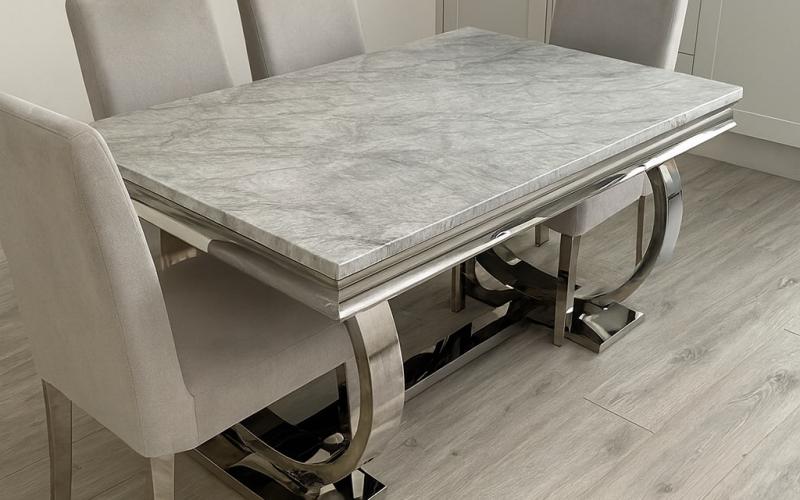
Two measurements decide which dining table a room can take: how much table edge each person needs, and how much floor you can afford to leave around it. The second is the one that catches people out. Here are the usual rules of thumb, matched to the sizes actually listed on our dining tables.
Start with the clearance, not the table
A dining chair needs roughly 50cm behind it to be pushed back far enough for someone to stand up, plus another 30cm or so if anyone walks past the back of a seated person. That gives the figure most guidance settles on: about 1m between the table edge and the nearest wall or furniture, on every side you intend to seat.
Where nobody walks behind — an end pushed towards a window, or a side you have accepted will go unused — 75cm is enough to get a chair out. Below that, the chair meets the wall before the person is clear of the table. These are rules of thumb, not measurements of a specific chair.
The quick version: add 2m to each dimension of the table and see whether it still fits your room. A 180 x 90cm table wants about 380 x 290cm of clear floor.
How much table each person needs
Allow around 60cm of table edge per place setting and about 40cm of depth for the setting itself. That is why a table much under 80cm deep struggles to seat people opposite each other with anything shared down the middle — the serving dishes end up on a side table.
Here is how the sizes in the range work out. The dimensions are those listed on each product page; the seat counts come from the rule of thumb above.
| Table size (W x D) | Seats (rule of thumb) | Clear floor with 1m all round | Examples in the range |
|---|---|---|---|
| 100 x 100cm square | 4 | 300 x 300cm | Lewis Square |
| 120 x 80cm | 4 | 320 x 280cm | Lewis, Venice |
| 150 x 90cm | 4, 6 at a push | 350 x 290cm | Chelsea, London, Siena |
| 160 x 90cm | 6 | 360 x 290cm | G-Jessica |
| 180 x 90cm | 6, 8 at a squeeze | 380 x 290cm | BK-Roma, G-Mayfair Gold |
| 200 x 100cm | 8 | 400 x 300cm | SG-Monaco, GS-Madrid |
| 90cm diameter | 2, 3 at a squeeze | 290cm across | Bentley Round |
| 110cm diameter | 4 | 310cm across | BK-Milan Round |
| 130cm diameter | 4 comfortably, up to 6 | 330cm across | Chelsea Round, London Round |
A worked example: a room 3.6m by 3.0m, door on a long wall. A 180 x 90cm table leaves 90cm at each end and 105cm at each side — tight at the ends, fine at the door. Narrow the room to 2.6m and the sides drop to 85cm: chairs still come out, but walking behind a seated guest stops being pleasant. Then the answer is 150 x 90cm, a 130cm round table, or a bench on the door side.
Round, square, or longer than it is deep
Round has no corners to catch a hip and no head of the table, which suits a square room and a household that talks across the table. Circumference is what seats people, so the gain from one size to the next is smaller than the diameter suggests: 90cm takes two, 110cm takes four, 130cm takes four comfortably or six at a squeeze. The base matters more here than anywhere else: a leg at the rim lands where a chair wants to be. The London Round Table is described as having an inward-curved pedestal that maximises legroom and the Chelsea Round Table uses a circular cross pedestal, while the Lewis Round Table stands on four tapered legs — so plan the chairs between them.
Square gives everyone the same amount of edge and keeps a square room looking square. The Lewis Square Dining Table is listed at 100 x 100 x 75cm: one setting per side, four in total, middle still in reach. Square stops working past about 120cm a side, because the centre gets too far away to serve from.
Longer than it is deep is most of the range, from 120 x 80cm up to 200 x 100cm, and it is the shape that seats six or more in an ordinary room. Three things to look at:
- Where the legs are. A four-leg frame such as the Lewis Dining Table puts a leg near each corner, fixing where the end chairs sit. Two end supports leave the long sides clear: the Chelsea Dining Table has circular legs at both ends joined by a supporting bar, and the BK-Roma stands on two. A single pedestal such as the BK-Milan cross base clears every side, but needs the chairs outside the foot.
- Whether you will use the ends. A 180cm table seats three a side; the two end places take it to eight, and they are the first to feel cramped.
- The depth. 80cm takes a place setting each side and little else; 90cm leaves a usable strip down the middle; 100cm, which is what the 2m tables are, takes a runner and serving dishes without anyone moving a plate.
When an extending table earns its place
There are six extending tables in the range. The useful question is what they open to, not what they close down to:
- Cheshire Extending Dining Table and London Extending Dining Table — 120-150 x 90 x 75cm, or 160-200 x 90 x 75cm.
- Torino 1.2/1.4m Extending Dining Table — 120-150 x 85 x 78cm, or 140-180 x 90 x 78cm.
- Lucca 1.2m Extending Dining Table — 120/150 x 85 x 78cm.
- Torino 1.1m Round Extending and Lucca 1.1m Round Extending — 110-150 x 110 x 78cm, round when closed and opening along one axis.
Three tests. Clearance at the open size, in the direction it grows: going from 160 to 200cm takes 40cm out of one end of the room, so that end has to be the end with the space. Where the extra chairs live otherwise: two spares take more room than people expect, and a pair that doubles as hall seating solves it. Height: the extending Torino and Lucca tables are listed at 78cm against 75cm on most fixed tables, which is enough to notice with a bench.
It does not earn its place if you entertain often enough that it would live open, or if the closed size is already tight. A table bought small because the room is small is still small almost all of the time.
Benches, and what fits underneath
Almost every fixed table here is listed at 75cm high, and our dining chairs give an overall height to the top of the back rather than a seat height — so if clearance under a table frame matters, measure it and ask us to confirm before ordering.
A bench buys clearance back, because it pushes right under the table when not in use. The Chelsea Dark Grey Bench is listed at 130 or 180 x 48 x 50cm and the Lewis Dark Grey Bench at 110, 130 or 160 x 48 x 50cm, so there is a length to suit most of the tables above. Two caveats: whoever sits in the middle climbs past everyone to get out, and a bench longer than the table side looks wrong. The rest are on our benches pages.
Measure it out before you order
Mark the footprint on the floor with masking tape, put a chair you already own at one edge and sit down, then push back as though you were leaving the table. That test tells you more than any figure here. Then check the route in — doorway widths, and the turn at a half landing — because a table top does not come apart. Delivery is free within 50 miles of our Glasgow store and £50 beyond, as set out on our delivery information page; if access is difficult, tell us on the contact page first.
Quick answers
How much space do I need behind a dining chair? About 1m from the table edge to the wall, and 75cm as the minimum on a side nobody walks behind.
Will a 180cm table seat eight? Three a side plus one at each end — but nobody will have much elbow room. A 200 x 100cm table is the comfortable eight.