04 Oct 2026
Crushed diamond and mirrored accessories: how to use them without overdoing it
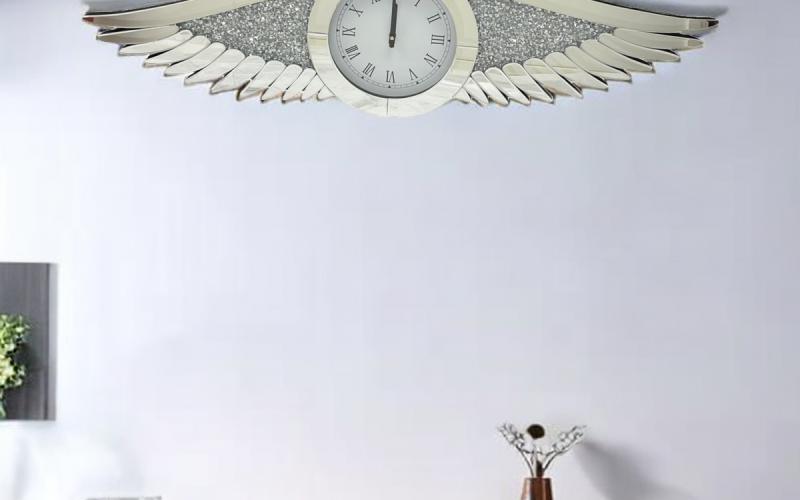
Mirrored furniture and crushed diamond effect accessories put light back into a room in a way no other finish does. One well-placed piece makes a north-facing living room brighter and a narrow hall less like a corridor. Several badly placed ones do the opposite: every surface catching the same lamp, and a room that feels busy rather than bright.
This is a guide to getting the first version. What the finish actually is, where reflective pieces work, how much sparkle a room will take, and what to put alongside it.
What "crushed diamond effect" means
It is a decorative finish, not gemstones. A band of glittering, faceted material is set into the frame of a mirror, the border of a clock or the base of a lamp, so it catches light from many angles at once — sparkle, rather than the flat shine of a plain mirror or a chrome leg.
The useful thing to notice when shopping is how wide that band is. Compare the SY1701 Wall Mirror, with its thick diamond effect border, against the SY1704 Wall Mirror, whose border is a thin strip. Both are described the same way; they behave completely differently on a wall. A thick border is decoration in its own right and wants space around it. A thin one is closer to a plain mirror with a detail, and sits happily above a busy sideboard or in a room that already has a lot going on.
The same scale applies to structure. The SY1702 Wall Mirror builds its border from geometric squares, the SY1705 Wall Mirror from fine diamond-patterned strips, and the SY1719 Wall Mirror from a staggered, layered edge. Which one to pick depends on how much visual work the wall is already doing.
One statement per sightline
The most reliable discipline is the simplest. Stand in each doorway, look across the room, and allow one reflective piece per view. Everything else reflective in that sightline should be smaller, quieter or out of the direct line.
That is a rule about hierarchy rather than quantity. A room can hold a large mirror, a mirrored coffee table and a diamond effect lamp quite comfortably, as long as it is obvious which one is the main event. Trouble starts when two pieces of similar size and similar sparkle sit opposite each other, bouncing light between themselves so neither one wins. For the same reason, be wary of hanging a large mirror directly opposite another mirror or a glazed door.
Then think about what the mirror will actually be reflecting. It shows you whatever faces it, so a piece opposite a window earns its place and a piece opposite a cluttered worktop simply doubles the clutter.
How much sparkle a room takes
As a rough starting point, by room:
| Room | One statement piece | Supporting pieces that work |
|---|---|---|
| Hallway | A tall wall mirror, or a mirrored console | A mirrored tray for keys; nothing else reflective |
| Living room | A large wall mirror above the sofa or fireplace | A diamond effect lamp, mirrored coasters, a small mirrored side table |
| Bedroom or dressing area | A dressing table, or a full-height mirror | A jewellery box, a tray, a table lamp |
| Dining room | A mirrored clock or a single wall mirror | Mirrored placemats and coasters on the table itself |
A small room is not a reason to use less, but it is usually a reason to use one larger piece rather than three small ones: a single big reflective surface opens a wall up, where several small ones chop it into sections.
Mirrored furniture: where it earns its place
Our mirrored furniture is mostly the Roma mirrored design, and it runs across a good part of a house: the Roma Dressing Table, the Roma Bedside Table, the Roma Coffee Table, the Roma Nest of Tables, the Roma Mirrored Stool, TV units, sideboards, bookcases and pedestals.
Worth knowing: the Roma name covers more than the mirrored pieces. There is also a Roma bed, the upholstered Roma Grey & Cream Mix Sofa and Roma dining chairs, none of them mirrored. Check the category a piece sits in rather than going by name.
It earns its place where a solid block of furniture would otherwise dominate — a console in a narrow hall, a coffee table in a small living room, a nest of tables you want to disappear when not in use. Reflective sides read as lighter than the same shape in a solid finish: the same floor area, less visual space.
It works least well anywhere that takes heavy daily handling in bright side light, because fingerprints show — an argument for putting the piece a step out of the main traffic route. A few pieces carry integrated lighting, including the Heart Console Table (LED) and the Diamond Stand 01 (LED); treat those as light fittings as much as furniture when you work out where a socket needs to be.
Clocks and lamps: sparkle that does a job
A reflective clock or lamp is easier to live with than a second mirror, because it has a function and so an obvious reason to be there.
Among the clocks, the mirrored-face designs come in matching round and square versions — the SY901 square and SY902 round share a crushed diamond border, with larger versions of each also listed. The SY903 Wall Clock uses a staggered mirrored frame instead, and the SY910 spreads two mirrored wings with diamond effect centres across 110cm of wall. For something reflective but not sparkling, the MD25 Wall Clock is a plain mirrored design, and the Table Clock can stand on a surface or go on the wall.
For lighting, the DMD12 Table Lamp and DMD02 Floor Lamp carry a crushed diamond effect finish across the body, while the MD02 Floor Lamp uses diamond-patterned strips for a more graphic look. The MD41/42 Table Lamp has diamond strip detailing and is offered in silver or rose gold.
One thing to check rather than assume: the options are not always the same across every size. The Angel Wings wall light, which pairs mirrored wings with diamond effect centres, is listed with colour LED at both 60 x 80cm and 90 x 120cm, but white LED only at the larger size. Each product page lists exactly which combinations are available.
Small accessories, and why they are the easy way in
If you are unsure whether the look is for you, the mirror ornaments are the low-commitment test. A Mirror Tray, the gold-framed G-MT03 Mirrored Tray, mirrored coasters with diamond effect surfaces, a mirrored jewellery box or the candle holders in small and large will all tell you quickly how the finish behaves in your light.
A tray also solves a specific problem: it gathers small objects into one reflective shape instead of leaving them scattered across a dressing table where the clutter would otherwise be doubled.
What to pair it with
- Matt surfaces. Sparkle needs something plain to read against — a matt wall, a wool rug, an unlacquered wood floor. Reflective against reflective cancels out.
- Texture rather than pattern. Boucle, velvet and linen give contrast without competing; a strong wallpaper pattern behind a diamond effect mirror usually loses.
- One metal temperature. Decide early whether the room is gold or silver and chrome, and keep lamp bases, clock frames and mirror frames on the same side of that line.
- A restrained palette. Two or three colours plus the reflective finish is plenty — the finish is already doing the work of an accent colour.
A short checklist before you buy
- Stand in the doorway and decide which single piece is the statement for that view.
- Check what the piece will face. A mirror reflects whatever is opposite it, for better or worse.
- Look at the width of the diamond effect border, not just the overall shape.
- Read the size and finish options on the page — they differ between sizes on some pieces.
- If the piece is lit, work out where the socket is before you choose the wall.
Seeing it in person
Reflective finishes are hard to judge from a photograph, because what you are seeing is the photographer's lighting rather than yours. Browse the wall mirrors and mirrored pieces online, and ask us what is on display in our Glasgow store if you would rather see a finish in person first. Delivery is free within 50 miles of the store, and £50 beyond that.