04 Oct 2026
Composite fencing for a Scottish garden: what a run actually needs
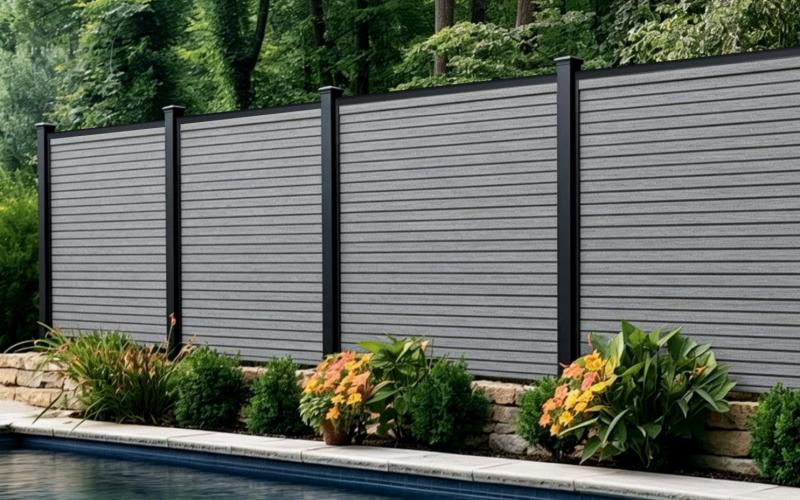
A composite fence run looks straightforward from the garden: a line of boards held between posts. Ordering one is where it gets fiddly, because almost nothing in the Fencing range is sold by the metre. Boards come in packs, posts come in packs, and how many of each you need depends on which board series you choose and on whether you are setting new posts or working with the concrete ones already in the ground.
This is a guide to counting, not to building. We sell the materials and nothing else — there is no fitting service here, and anything structural, from digging post holes to deciding what an exposed boundary should be, belongs with a tradesperson and with the manufacturer's own fitting instructions. What follows is simply what the parts are and how many of each a run swallows.
Four parts, and only one of them is the boards
The range divides into composite fence boards, composite posts, a fitting kit for hard surfaces, and trims. There are also two decorative lattice panels, which are aluminium rather than composite. The boards are the part everyone prices first; the posts, kits and trims are the half of the order that gets forgotten.
The boards
Composite fence boards come in three series — 86, 88 and 94 — and they differ in one way that matters to your order: how wide each board is. All three are 180cm long and sold six pieces to a pack.
| Board series | Size per board (fitted) | Pieces per pack | Coverage per pack | Packs per 1.8m bay |
|---|---|---|---|---|
| Fencing 86 | 15 × 180 × 2cm | 6 | 1.62m² | 2 |
| Fencing 88 | 16 × 180 × 2cm | 6 | 1.73m² | 2 |
| Fencing 94 | 30 × 180 × 1.8cm | 6 | 3.24m² | 1 |
Those last two columns come straight from the listings, which express the quantity as packs "per fence panel" — one bay, 180cm wide and roughly 180cm high. Twelve of the 15cm-wide 86 boards stack to that height, which is why the 86 and 88 series are quoted at two packs a bay, while the 30cm-wide 94 boards get there in a single pack of six. Note that twelve 88 boards at 16cm each stack a little higher than twelve 86 boards, which is why the 88 is quoted at 1.73m² a pack against the 86's 1.62m².
Finishes differ by series too. The 86 boards are listed in Oak 03, Grey, Dark Brown, Black and Khaki — Fencing 86A – Oak 03 through to Fencing 86F – Khaki. The 88 series is close but not identical — Oak 03, Grey Oak, Dark Brown, Black and Khaki — so if you are matching an existing run, check the shade name rather than the letter. The wider 94 series runs differently: Fencing 94A – Oak, 94B – Grey Oak, 94D – Dark Oak and 94T – Walnut.
The posts
Two composite posts, both black. The 6" Fence Post – Black is 8 × 8 × 190cm and comes four to a pack. The 8" Fence Post – Black is 10 × 10 × 240cm and comes two to a pack; its description says it is designed to be buried 2" underground for strength and stability. Both are described as three-way posts with grooves 20mm wide and 18mm deep, and both listings say they are made to accommodate 2cm-thick boards — which is the 86 and 88 thickness. The 94 board is 1.8cm, so confirm the pairing on the listing and in the fitting instructions before you order a run of it.
Count posts, not bays: six bays need seven posts. A corner or a change of direction needs one as well, which is what the three-way profile is for.
The fitting kit
If posts are going onto a hard surface rather than into the ground, the Fence Post Fitting Kit – Black is the part that anchors them. Its description lists a post hat, a base cover, a mounting bracket and stainless steel bolts per set, with four complete sets to a carton, and says it is designed for concrete slabs, tarmac and similar floors.
The trims
Two trims: Fencing 86 Trim – 180cm at 4 × 180 × 4cm, and Fencing 94 Trim – Black – 180cm at 4 × 180 × 4.5cm. Both come four pieces to a pack and both are described as fitting standard 40mm concrete post installations, cut to length, to finish the top and bottom edges of a panel. That makes them the route for replacing timber panels between concrete posts you intend to keep: the boards sit in the trim rather than in a new composite post.
One labelling quirk worth knowing — there is no trim named after the 88 series. The 88 board listings point at the 86 and 94 trims instead. If you go hunting for a "Fencing 88 Trim" you will not find one, and nothing is missing from the range.
A worked example: a 10.8m run
Say a 10.8m boundary, finished at about 1.8m high, with new composite posts going into the ground. Boards are 180cm long, so the run divides into six bays of 1.8m with nothing to cut.
- Boards, 94 series: one pack a bay, so six packs. At 3.24m² a pack that is 19.44m² of board.
- Boards, 86 series instead: two packs a bay, so twelve packs at 1.62m² each — the same 19.44m², in twice as many narrower boards.
- Posts: seven. The 6" post comes four to a pack, so two packs, which leaves one spare.
- Trims: none on this route. The boards slide into the posts' grooves.
Change one assumption and the list changes with it. On a concrete patio or a tarmac drive, add fitting kits: seven posts at four sets a carton means two cartons. Keep the existing 40mm concrete posts instead and you drop the posts and the kits entirely, but add trim for the top and bottom of every bay — twelve 180cm lengths, four to a pack, so three packs.
A run that does not divide neatly into 1.8m needs a part bay, and a cut board is still a whole board off the pack. Measure the real distance between fixed points before ordering and allow for it rather than rounding down.
Lattice, if you want to break up the line
Fence Lattice 01 – Flower and Fence Lattice 02 – Strips are decorative panels measuring 180 × 30 × 0.2cm. These two are aluminium, not composite: the descriptions call them lightweight aluminium sheet with top and bottom trim strips, one of them grooved to lock into standard fence panel trims, and each pack holds one lattice, two trims, two L-connectors and eight screws. They are an insert for an existing fence framework rather than a structural panel.
Matching the rest of the garden
Finish names repeat across the outdoor ranges, which is the useful part if the fence is not the only thing changing. Oak 03, Grey, Dark Brown, Black and Khaki all appear in the 86 fence boards, the 85 boards in Decking and the 83 series in Outdoor Wall Panels, so a boundary, a deck and a clad wall can be specified from one shade list. Compare the listing photographs before committing a whole run — a shared name across three product series is a sensible starting point rather than a promise that two batches will look identical side by side.
Before you order
- Measure the run and divide by 1.8m for the bay count. Posts are bays plus one.
- Decide new posts or existing concrete posts first — it changes which parts you need entirely.
- Check each board listing for its own coverage figure rather than assuming the series behaves like its neighbour.
- Read the panel listing for the trim and post it names, not the trim's own title.
- Follow the manufacturer's fitting instructions, and talk to a tradesperson about anything structural.
Everything in the range is bought in from a supplier and sold as materials. Delivery is free within 50 miles of our Glasgow store and £50 beyond. If you are not sure which parts a particular run needs, the "Ask question about this product" button on any listing reaches us directly.