04 Oct 2026
Choosing a wall mirror: size, shape and where to hang one
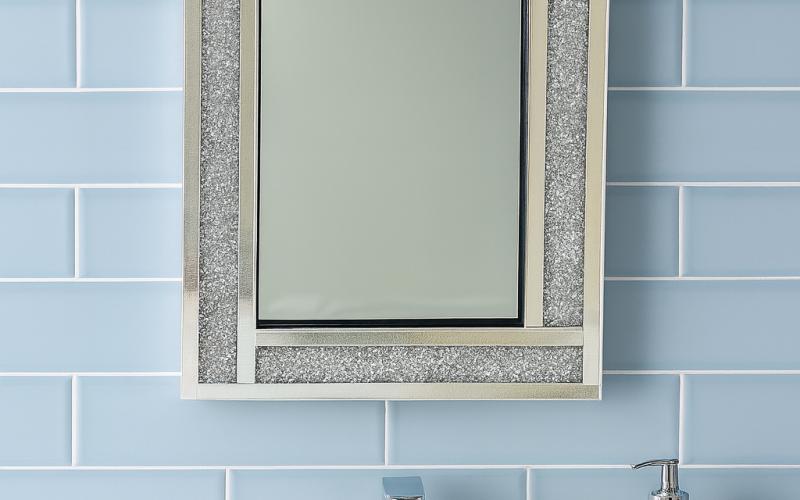
Most mirrors that look wrong on a wall are not the wrong mirror. They are the right mirror at the wrong size, or hung at the wrong height above the wrong piece of furniture. Getting those three things right matters more than the frame.
So this guide works outwards from the furniture rather than inwards from the mirror. Measure first, then choose.
Start with the piece beneath it, not the wall
The rule of thumb worth knowing is this: a mirror hung above a piece of furniture should be roughly two-thirds the width of that piece. Anything much narrower looks stranded; anything wider than the furniture itself looks like it has been hung in the wrong place.
Two-thirds is a starting point rather than a law. If the wall is wide and bare, you can push towards three-quarters. If there are wall lights or a switch either side, come back under two-thirds. But working from the furniture gives you a target width before you start browsing, which is the whole point.
Some worked examples using pieces we stock:
| Furniture beneath | Its width | Target mirror width | Sizes that fit |
|---|---|---|---|
| V Console Table | 110cm | about 70–80cm | 70 x 100cm or 80 x 120cm |
| Heart Console Table (LED) | 120cm | about 80cm | 80 x 120cm, or an 80cm round |
| Roma Dressing Table | 110cm | about 70–80cm | 70 x 100cm, or a tabletop mirror |
| A three-seater sofa | around 220cm | about 140–150cm | Usually a pair, or one wide landscape mirror |
That last row is the common trap. A wall mirror wide enough to balance a three-seater sofa is a large object, and our sizes top out well below it. Two matched mirrors hung side by side will usually do the job better — the G-M015 Gold and Black Wall Mirrors are sold as a pack of two 90cm rounds, one gold and one black, for exactly that kind of arrangement.
Height: where the centre should sit
For a mirror hung on its own, aim to have the centre of the glass at roughly standing eye level. That lands most people somewhere around 145 to 155cm from the floor. It is worth measuring the people who actually live there rather than taking the number on trust.
For a mirror hung above furniture, the height is decided by the gap instead. Leave something in the region of 15 to 20cm between the top of the furniture and the bottom of the frame. Less and the two pieces read as one awkward block; more and the mirror floats free of the thing it is meant to sit with.
Above a dressing table, both rules give way to a third: you need to see your face while seated. Sitting down drops your eye level by around 40cm, so a mirror positioned for someone standing will be too high. This is where a tabletop mirror often beats a wall-hung one — the three-sided G-SY628 Tabletop Mirror and the SY6303 both sit on the table and reflect at seated height by default.
Room by room
Hallways
Halls are narrow, so the mirror wants to be tall rather than wide. A portrait shape at 40 x 120cm takes almost no wall and still gives a full head-and-shoulders reflection on the way out of the door; it is one of the sizes offered on the SY1704, SY1705 and SY1710 mirrors, and on the bevelled 8008 Wall Mirror.
If you want full-length in a hall, consider a free-standing mirror instead of fixing one. The G-M011 Free-Standing Mirror is 40 x 140cm in a simple gold frame and the F1710 Free-Standing Mirror is 50 x 160cm. Both lean against the wall, which suits a rented home or a wall you would rather not drill. They do need positioning somewhere they will not be knocked.
Living rooms
Above a fireplace, the chimney breast usually sets the width for you and a round mirror tends to sit better than a rectangle, because it does not compete with the mantel's own straight lines. The PU006/007 Wall Mirror comes as an 80cm or 100cm round, and the SY1720 Wall Mirror is a 100cm round with a partitioned mirrored border.
Against a long blank wall, the thing to check is not size but what the mirror faces. Hung opposite a window it pulls daylight across the room, which is the main reason to put a mirror in a living room at all. Hung opposite a television it reflects a black rectangle all evening.
Dressing tables and bedrooms
Here a three-sided mirror does something a flat one cannot: the angled outer panels let you see the sides of your head at the same time as the front. The SY6302 and SY6303 are both 77 x 55cm three-sided designs, and the SY6308 is a three-panel version at 83 x 61cm with a plain central panel and diamond effect outer ones.
For full-length in a bedroom, the Wooden Frame Mirror runs at 80 x 160cm and 100 x 200cm, in champagne, dark silver or gold.
Shapes, briefly
- Portrait rectangle. The safe default. Adds apparent height, fits narrow walls, works above almost anything.
- Round. Softens a room full of straight edges and is forgiving about exact placement, because there is no horizontal line to get level.
- Landscape rectangle. Suits a wide, low piece — a sideboard or a long console — where a portrait shape would look like it was reaching.
- Everything else. Octagons and hearts, like the 80 x 80cm SY1761 Octagon (LED) and the 70 x 90cm SY1760 (LED), are decorative pieces first. Treat them as you would a picture rather than as the room's main mirror.
One practical note on shape: the same design is often offered in both. The SY1701 Wall Mirror is listed as an 80 x 120cm and 80 x 160cm rectangle and as an 80cm and 90cm round, so you can keep the frame and change the geometry.
LED mirrors
An LED mirror has lighting built into or around the frame, usually concealed so you see the glow rather than the fitting. The point of it is even, front-on light for makeup and grooming, which a ceiling light cannot give you — overhead lighting casts shadows down your face, and a lit mirror does not.
Our LED mirrors sit in two groups. Vanity-sized: the SY6306 (LED) is a circular mirror with a crushed diamond effect border and a concealed LED perimeter. Full-height: the F1761 (LED) Free-Standing Mirror is 55 x 160cm, free-standing, with LED running around a diamond effect border.
Two things to settle before you buy one. First, where the power comes from — check the product page and ask us if it is not clear, because it decides which wall you can use. Second, whether you want light at all in that position. In a hall, a lit mirror at night is useful; above a dressing table it is the main reason to choose one; in a living room it is usually one effect too many.
Before you commit
- Measure the furniture, take two-thirds, and shop to that width.
- Cut the shape out of newspaper and tape it up for a day. It costs nothing and settles most arguments.
- Stand where you normally stand and check what the mirror will reflect.
- Check what the wall is made of and use fixings suited to it. A large mirror is a heavy object on a hook.
- Read the size list on the page — several of our designs share a product page across four or more sizes.
You can see the full range of wall mirrors online, and seeing a frame in real light is the quickest way to judge it — ask us what is on display in our Glasgow store. Delivery is free within 50 miles of the store, and £50 beyond that.