28 Jul 2026
Velvet vs Bouclé: The Best Fabric for a Bed Frame
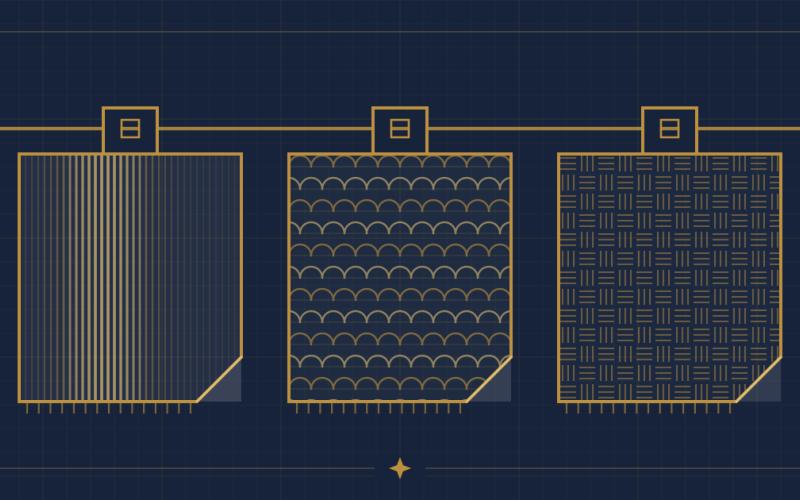
If you want depth and a surface that changes as you walk past it, choose Plush Velvet. If you want texture, warmth and something that hides everyday life better, choose Teddy Bouclé. The three weaves in between — Fusion Linen, Naples Weave and Arlington — are the calmer options, and usually the right answer for a room that gets properly used. Every bed is upholstered to order in the fabric and colour you pick, and a £2 swatch is the only honest way to decide.
Velvet vs bouclé: the five fabrics at a glance
| Fabric | Surface | How it takes light | Best suited to |
|---|---|---|---|
| Plush Velvet | Dense pile with a direction to it | Shifts as you move; the most dramatic | Statement rooms, deep colours |
| Teddy Bouclé | Looped, nubby, soft to the hand | Matte and quiet; almost no shine | Informal schemes; pale colours |
| Fusion Linen | Flat linen-look weave | Even in any light | Calm schemes; already-busy rooms |
| Naples Weave | Plain up close, stronger at scale | Steady; gains presence across a headboard | Large beds |
| Arlington | The plainest of the five | Even, so the colour does the work | Colour-led rooms |
Plush Velvet: the one that changes with the light
Velvet is never quite one colour. The pile has a direction, so brush it one way and the shade deepens; brush it back and it lifts and catches the light. Standing at the door you see one tone, sitting on the bed you see another. On a tall headboard, that movement is the whole point of the fabric.
The honest cost is that velvet shows everything it does. Lean against a velvet headboard and you leave a mark in the pile — it brushes out, but it is there, and pale velvets record every hand and pillow. It is also the fabric that photographs least reliably, so it is the one we most suggest you see in person.
Velvet suits you if you want the bed to be the thing you notice, and you are choosing a deeper shade — Forest, Ox Blood, Denim and Charcoal all gain from a pile. Think twice if the bed doubles as a sofa for children on a Saturday morning.
Teddy Bouclé: texture before colour
Bouclé is a texture first. The looped yarn gives a soft, nubby grain that takes light in a matte, unfussy way, and that combination of softness and no shine is why bouclé reads warm even in a cold north-facing room. It is the friendliest of the five to touch.
The loop is also its weakness. It is the surface most likely to be pulled by a claw, a zip or a ring, and a pulled loop does not settle back the way a crushed velvet pile brushes out. It holds dust in the texture, too, so it likes a vacuum more often.
Bouclé suits you if you want a soft, low-slung, informal bed and lean towards pale shades — Silver, Mink, Blush and Duck Egg all look considered in bouclé, where in velvet they can look chalky. Think twice if you have a cat.
Fusion Linen: the quiet default
A linen-look weave is flat, even and has a visible grain running through it. It behaves predictably in every light, which is what you want in a room that already has patterned curtains or a busy rug. It also has a practical advantage over pile: no nap means no shading, no crush marks and nothing to brush back into place.
Fusion Linen suits you if you want the bed to be furniture rather than a feature — Truffle, Mink and Silver are the natural pairings. Think twice if you wanted the depth velvet gives a dark colour; a flat weave reads lighter in the same shade.
Naples Weave: made for large beds
Naples has a woven texture that barely registers in a small square held in the hand, then becomes clearly visible stretched across a headboard. That is the reason to choose it: on an Emperor or Super King, a texture that is subtle in the palm is often exactly right at full size, where something bolder would dominate the room.
Naples suits you if you are ordering one of the larger sizes and want texture without drama — judge its swatch at arm's length, propped where the bed will stand. Think twice if you are choosing for a small single or a footstool, where the texture has too little area to do anything.
Arlington: when the colour is the decision
Arlington is the least demonstrative of the five. It puts little between you and the colour: no pile shifting the tone as you move past it, no loop breaking up the surface. What you choose is broadly what you get.
That makes it the fabric where getting the shade right matters most, and colour is the hardest thing to judge on a screen. A shade that looks quiet on a small square usually reads deeper across a headboard, and shifts again under your own lamps — Saffron and Ox Blood in particular are far stronger at full size than they look in a photograph.
Arlington suits you if you have a colour in mind and want it delivered plainly. Think twice if you want visible texture.
Pets, children and rooms that get used
If the bedroom is busy, the ranking is simple. The flat weaves cope best, because there is no pile to crush and no loop to pull. Velvet is next: it marks readily, but most of that brushes out. Bouclé is the one to be careful with around claws.
Colour does as much work as fabric here. Charcoal, Truffle, Forest and Denim forgive daily life in a way Blush, Silver and Duck Egg do not, in any of the five cloths. For a child's room, a mid-to-dark shade in a flat weave is the most forgiving combination — worth bearing in mind when you choose a children's bed. The same applies to ottomans and footstools, which take more feet and more spills than anything else in the room.
Cleaning and everyday care
- Vacuum regularly with a soft brush attachment on low suction — most important for bouclé, where dust settles into the loop.
- Blot spills, never rub. Press a clean, dry, light cloth straight down and lift. Rubbing drives liquid deeper and disturbs a velvet pile permanently.
- Brush velvet back. Seat prints lift out with a soft brush worked in the direction of the nap.
- Never pull a snagged loop. On bouclé, cut it flush with sharp scissors instead.
- Keep upholstery out of strong direct sunlight, which fades a headboard unevenly if only one end catches it.
- Ask before using any cleaning product. Shop-bought upholstery foams are not suitable for every cloth; ask us what is safe on yours.
Order swatches and judge them in your own light
Everything above is a starting point. No photograph can tell you how a fabric behaves in your bedroom, under your bulbs, against the carpet you are not replacing. Our fabric samples cost £2.00 each and are posted out in around 7 to 10 days. If you are torn between two fabrics, order both — a side-by-side comparison in the actual room usually settles it. Look at each swatch twice — once in daylight, once under a lamp — and hold it upright, as it will sit on a headboard.
One honest caveat: every bed is upholstered individually from its own roll of fabric, so the finished piece can vary by up to approximately 10 per cent in colour against the swatch in your hand.
When you have decided
Fabric and colour are chosen as part of the order, not before it: pick the bed, then set size, fabric and colour in the configurator on the product page, and the price updates as you go. Nothing is held in stock — each piece is made to order, which is why the lead time is typically 4 to 6 weeks.
From there it is a question of which frame you want the fabric on: browse our upholstered bed frames if the headboard should carry the room, or look at divan beds if you would rather the base did the work. Delivery is free within 50 miles of our Glasgow store and £50 beyond it — the Glasgow delivery page sets out the area in full.