23 Jul 2026
Ottoman Bed vs Divan Bed: Which Storage Bed Suits You
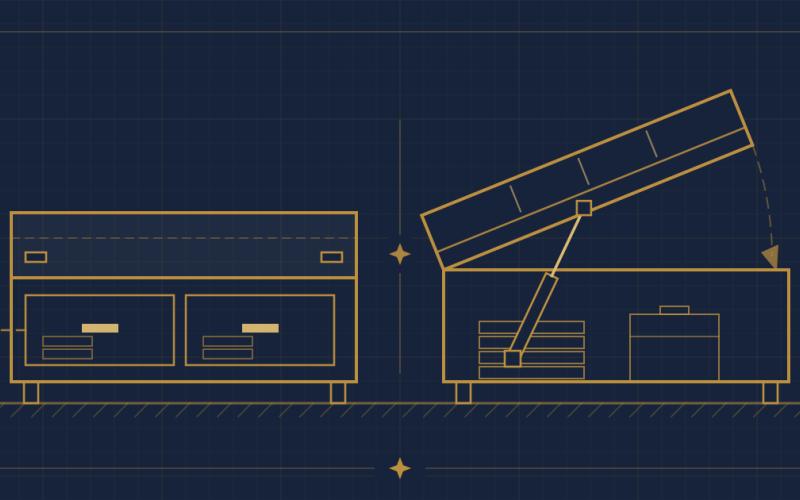
An ottoman bed and a divan bed solve the same problem in different ways. An ottoman lifts the whole mattress on gas struts to open one large compartment underneath; a divan is an upholstered base carrying the mattress, which may be solid, fitted with drawers, or built to lift like an ottoman. For bulky, occasional things — spare duvets, suitcases, out-of-season clothes — the ottoman wins on volume. For things you reach for every week, drawers are quicker and take less effort.
Neither is universally better. The right answer usually comes down to the room rather than the bed.
What an ottoman bed is, and how the lift works
An ottoman bed has a hinged platform carrying the mattress. Two gas struts, much like the ones holding a car boot open, take most of the weight as you raise it and hold it open while you load. Underneath is a single compartment running almost the full footprint of the bed, less the thickness of the base sides.
How that compartment is built matters more than most listings admit. A cheap ottoman uses a slatted lift, which flexes under a heavy mattress and leaves stored items sitting on the floor between the slats. Order one of our upholstered frames with gas-lift ottoman storage and it is built instead on a solid ottoman base, made in two halves: a continuous surface for the mattress to rest on and a stiffer storage space inside. The Chanel, Belle, Empire, Lusso and Suki are all offered this way — browse the bed frame range to see which shapes take the option.
What a divan bed is
A divan is the more traditional British arrangement: a fully upholstered base with the mattress laid on top and a headboard fixed to the base or the wall. Because base and mattress are separate, a divan tends to sit slightly higher than a frame, which many people find easier to get in and out of.
Traditionally, divans carry storage in drawers built into the sides or foot of the base. Most of the divans we sell are solid-based rather than drawered, so the fabric and the headboard do the work; the two Wall Panel beds are the exception, arriving with two drawers included and a gas-lift ottoman upgrade available instead. You can see the shapes and headboard heights across our divan bed range.
Ottoman bed vs divan bed: how much storage each really gives you
This is where the difference is starkest. A drawer holds only what fits in the drawer box, and the box is shallower than the base and shorter than the bed. Drawers give you a few modest compartments; an ottoman gives you one very large one.
| Gas-lift ottoman | Drawer divan | |
|---|---|---|
| Usable volume | Almost the whole footprint under the mattress | Only the inside of the drawer boxes |
| Best for | Duvets, suitcases, seasonal clothes, bedding sets | Folded clothes, linen, things used weekly |
| Effort to open | Clear the bed, then lift on struts | Pull a handle |
| Space needed | Height above the bed to swing the mattress up | Floor clearance at the side or foot to pull drawers out |
| Awkward moment | Cannot open it with things on the bed | Cannot open a side drawer if the bed is against a wall |
The practical catch with an ottoman is that anything loose has to come off the bed before you open it — a glass of water, a laptop, a folded throw. Fine for a space you visit once a month; genuinely irritating daily. Be honest about which one you are describing.
Side-lift or end-lift
Ottomans are made to open in one of two directions, and the choice is dictated by the room more than by taste.
- End-lift hinges at the head of the bed and the mattress swings up towards the headboard. You stand at the foot to open it. This suits a bed pushed into an alcove or with one long side against a wall, because you only need clear floor at the foot.
- Side-lift hinges along one long side, so you need clear floor on the opposite side to stand and lift. It suits a bed with both sides free, and is often the easier lift on a wide bed because you work across the shorter span.
Two things to check. A sloping ceiling or a low windowsill behind the bed can stop an end-lift mattress clearing, so measure the arc and not just the floor. And if the bed will only ever be approached from one side, make sure it opens on the side you can reach. If you are unsure how a particular bed is built, ask us before ordering rather than after.
Weight, struts and floor clearance
Struts are sized to the platform, not to your mattress, so mattress weight changes the effort noticeably. A deep pocket-sprung super king is a substantial thing to raise; if you are buying both together, factor weight into the choice from the mattress range. Struts also lose pressure over the years, making the bed heavier to open. Replacing a pair is cheap next to replacing a bed, but it is a maintenance item — though drawer runners bind and wear too.
On clearance, a drawer divan needs clear floor beside or in front of each drawer for the full depth of the box, which in a narrow bedroom is often the deciding constraint. Thick carpet can foul a drawer as it slides, too. An ottoman needs almost no clearance at the sides — which is exactly why it suits small rooms — but it does need height and access at the hinge end.
Measure before you order: the ottoman version is smaller
One detail catches people out. On our frames, the ottoman version measures slightly smaller overall than the standard build, because the base sits flush with the mattress and the headboard runs down flush to the floor. Small difference, but in a tight alcove it is the one that matters. Everything is upholstered by hand after ordering, so allow a few millimetres of tolerance, and measure the route in — doorways, landings, the turn at the top of the stairs.
Which one suits which room
- Small bedroom, no wardrobe space: an ottoman. It turns the biggest area of dead space in the room into usable storage without needing floor clearance around the bed.
- Bed against a wall or in an alcove: an ottoman, specified as an end-lift. A side-drawer divan will lose half its drawers to the wall.
- Things you reach for every day: a drawer divan. Opening a drawer takes a second; opening an ottoman takes a minute and a clear bed.
- Guest room, or storage is not the point: a solid divan base or a plain frame. A mechanism you never use is a mechanism you paid for.
- Anyone who finds lifting difficult: drawers, or no storage in the bed at all. Struts help enormously, but you are still guiding a mattress up and down.
The third option: keep the storage out of the bed
Storage does not have to live under the mattress. An upholstered ottoman box at the foot of the bed takes spare duvets, blankets and, in a child's room, a floor's worth of toys, and it closes the end of the bed with a finished line instead of a gap. Both are made to order, so the upholstery can be chosen to match the bed. If you would rather keep the bed itself simple, look at our ottoman boxes and footstools.
Ordering either one
Every bed is built to order. You choose the size — small single through to emperor — then the fabric from Plush Velvet, Teddy Bouclé, Fusion Linen, Naples Weave and Arlington, and the colour from ten shades including Charcoal, Duck Egg, Mink and Ox Blood. Nothing is held in stock, so the storage configuration and the finish are settled before anything is cut. Allow roughly four to six weeks. If you are torn between fabrics, order samples first at £2.00 each; they are far more reliable than a photograph on a screen. Delivery is free within 50 miles of our Glasgow store and £50 beyond, as set out on the delivery information page.
Still undecided? Count how many times a week you would open it. Weekly or more, buy drawers. Monthly or less, buy the ottoman and enjoy the space.