18 Jul 2026
How to Choose a Mattress in the UK: An Honest Guide
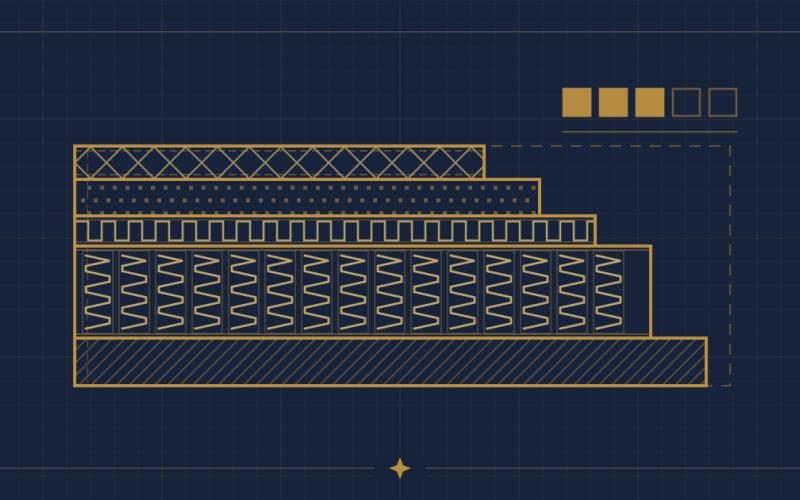
Choosing a mattress in the UK comes down to four decisions, in this order: the construction you want (pocket sprung, memory foam or gel hybrid), how firm it should feel, whether it suits the position you actually sleep in, and how deep it can be without swallowing your headboard. Get those four right and the rest is detail.
Every mattress we sell is made to order, typically in four to six weeks. That is an advantage, but it does mean deciding properly the first time.
Choosing a mattress in the UK: three constructions and what each is good at
Almost every mattress in our mattress range is one of three things. The names get used loosely, so here is what they mean in practice.
Pocket sprung
Each spring sits in its own fabric pocket and compresses on its own. Because the springs work independently, the surface follows the shape of your body in sections rather than answering as one slab, and movement stays local — a partner turning over travels far less across the bed. Springs also leave air gaps, which is why a sprung core generally sleeps cooler than a solid block of foam.
Spring count is the number everyone quotes. It is a guide to how finely the mattress reads your shape, not a quality score, and a quoted count usually refers to one particular size, so the same model in a single has fewer springs. Ours run from 1,000 springs on the Sian Hybrid to a 10,000-count unit on the Opulence. Beyond about 2,000 you are paying for finer contouring and better fillings rather than for the number alone.
Memory foam
Memory foam softens with body heat and moulds around you, so the shoulders and hips settle in rather than being pushed back at. It absorbs movement better than anything else, which matters if you wake when someone else shifts. The two common complaints are that it can sleep warm and feel slow to respond when you change position. The Memory Elite answers both by laying 50mm of memory foam over a firm spring unit, so you get the softer surface without the whole-body sink.
Gel hybrid
A hybrid puts a foam comfort layer over a pocket spring core, and gel-infused foam is engineered to carry heat away from the surface rather than store it. This is the sensible default for most people, and it is where most of our range sits: the Sian Hybrid (1,000 springs, 50mm of gel foam), the Sian Pro (2,000 springs, 60mm), and the Gel Advanced 3000, which adds 1,000 micro springs above the main unit for finer contouring. If you sleep hot and still want the responsiveness of springs, start here.
| Construction | Feels like | Best for | Watch out for |
|---|---|---|---|
| Pocket sprung | Responsive, supportive, bouncier | Sharing a bed; anyone who sleeps warm | Spring count is a guide, not a grade |
| Memory foam | Cushioned, close-contouring, still | Light sleepers; restless partners | Can hold heat; slower to respond |
| Gel hybrid | Cushioned surface, springy underneath | Most people, most of the time | Depth adds up quickly — measure first |
Firmness: read the scale, not the word
Firmness is not standardised across the trade. One maker's "medium" is another's "medium-firm", so treat a rating as a guide to where a mattress sits within that maker's own range. Where we give a number, you will find it on the product page — the Balmoral is a soft 3.5 out of 10, the Duel Season 1000 sits at 7 out of 10, and the Sian Elite PRO PLUS+ is an 8, which is genuinely firm.
Two things shift the answer more than people expect. The first is body weight: the same mattress reads softer to a heavier sleeper and firmer to a lighter one, so a couple with a large weight difference will not experience the same bed. The second is what it sits on — a solid platform or divan base feels firmer than a sprung slatted base, so factor that in before you go up or down a grade.
Sleeping position
- Side sleepers carry most of their weight on the shoulder and hip. You want enough give at those two points that they sink in rather than being propped up — soft to medium usually, and a foam or gel comfort layer earns its keep here.
- Back sleepers generally do best in the middle: medium to medium-firm, enough support that the hips do not drop away, enough cushioning that the small of the back is not left bridging a gap.
- Front sleepers need the firmest of the three. A soft mattress lets the hips sink and arches the lower back, which is what tends to leave front sleepers uncomfortable by morning. Medium-firm upwards.
- Combination sleepers — most of us — should choose for the position they fall asleep in, and favour a responsive sprung or hybrid surface that recovers quickly on movement.
Two people, two preferences
There is no perfect answer, but three things work in practice.
Split the difference honestly. If one of you wants soft and the other firm, a genuine medium is a real compromise rather than a fudge — and the firmer sleeper can add a topper far more easily than the softer sleeper can subtract one.
Prioritise motion isolation. If the actual complaint is being woken rather than comfort, that is a construction problem, not a firmness one. Individually pocketed springs and foam comfort layers both damp movement well; higher spring counts do it best.
Look at edge support. An encapsulated or reinforced edge gives you the full width to sleep on instead of rolling towards the middle — the least glamorous line on a spec sheet and one of the most noticeable in use.
Depth, and why it decides your headboard
Depth is the measurement people forget. Our deeper mattresses run to around 27cm on the Royal and the Duel Season 1000, and 30cm on the Balmoral. Every one of those centimetres raises the sleeping surface and eats into the headboard above it.
Before you order, measure from the floor to the top of your frame or base, add the mattress depth, and compare that against the height of your headboard. A deep mattress on a divan base can leave surprisingly little headboard showing, because the base is already substantial — fine if you have chosen a tall headboard, less so if you have not. Many of our upholstered bed frames list a headboard height on the product page; where one is given, the sum is easy to do in advance, and where it is not, ask us before you order. Also check that your fitted sheets will stretch over a 30cm mattress.
Turning, rotating and no-turn
Older mattresses were built to be flipped. Modern ones increasingly are not: the comfort layer is engineered to be on top and only on top. Three patterns exist in our range:
- Double-sided, turnable. The Royal, the Balmoral and the Duel Season 1000 can be flipped as well as rotated, spreading wear across two faces. The Duel Season goes further and gives each face a different character — memory foam for winter, a lighter fibrous surface for summer.
- Single-sided, rotate only. The Euphoria 1000 has its comfort layers built into one face. Turn it head to foot, never over.
- No-turn. The Gel Advanced 3000 asks for nothing more than an occasional rotation.
Whichever you buy, rotate it every few months in the first year and twice a year after that — the cheapest way to keep a mattress wearing evenly.
Before you order
Choose your size first — our mattresses run from Small Single up to Emperor, and the sizes listed on each product page are the definitive set — then the construction, then the firmness. Because everything is made to order, allow four to six weeks. Delivery is free within 50 miles of our Glasgow store and £50 beyond it; the delivery information page explains how that works. And if you are buying an upholstered bed at the same time, order fabric samples before committing to a colour: they are £2 each, and seeing Plush Velvet or Teddy Bouclé in your own light is worth the wait.
Still weighing two options against each other? Tell us what you sleep on now and what is wrong with it — usually a faster route to the right mattress than comparing spec sheets.